


What You’ll Learn in this blog:
- How 4 leading AI tools perform in life science content development
- My choice for overall winner
- How to improve your personalized AI workflow
Life science marketing professionals are rapidly adopting AI tools — but most lack a clear framework for evaluating which tools actually deliver value across scientific content workflows.
Without a structured approach, teams risk producing inaccurate or low-quality content, misallocating resources, and falling behind competitors using AI more strategically. This can impact everything from regulatory credibility to campaign performance and executive trust.
This blog breaks down a real-world, task-based evaluation of the four leading AI tools and translates it into a practical, workflow-driven framework — so you can confidently match the right tool to the right job, and elevate your life science content marketing impact.
Which AI Tool Wins for Life Science Content Marketing?
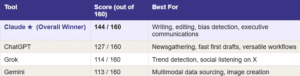
At Sciencia, I didn’t rely on opinion — I ran the tests. Over several weeks, I evaluated ChatGPT, Claude, Gemini, and Grok across 28 standardized content tasks using an identical prompt library. Every tool was scored on scientific accuracy, strategic utility, and editorial quality on a 1–5 scale. All testing was conducted at the highest paid tier for each model.
The findings are clear: while all four tools have genuine strengths, one rises above the rest for the high-stakes, nuance-driven demands of life science AI marketing — and the others each earn a specific place in a well-built workflow.
THE OVERALL SCORES
WHY CLAUDE LEADS FOR LIFE SCIENCE CONTENT
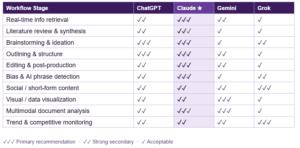
Claude scored highest across the workflow categories that matter most in life science content marketing — research and evidence synthesis, editorial refinement, bias, outline development, and executive-level communications. It is the only tool to achieve that level of consistency across all categories simultaneously. In specific tasks like post-editing scientific articles, grammar review, meta description writing, and podcast script generation, it ranked first every time.
What makes Claude particularly powerful for life science is its 200K-token context window. This allows entire research papers, clinical trial data, and regulatory filings to be loaded directly into a single session, grounding content in primary sources rather than summaries or approximations. Rather than working from truncated inputs or requiring documents to be broken into fragments, Claude can hold the full complexity of a study — methodology, results, limitations, and supplementary data — in a single working context. That matters enormously when accuracy is non-negotiable and downstream errors carry regulatory or reputational risk.
Its scientific reasoning spans pharmacology, genomics, clinical methodology, and biostatistics. Claude understands mechanisms, not just terminology. It can interrogate a trial design, flag underpowered endpoints, contextualize a biomarker within a disease pathway, and translate that into crisp, audience-appropriate language — whether that audience is a specialist clinician, a lay patient, a C-suite investor, or a policy stakeholder. It shifts fluidly between HCP white papers, patient-facing copy, investor briefings, and podcast scripts without sacrificing rigor or requiring extensive re-prompting to recalibrate tone.
For life science organisations, choosing an AI is also a compliance decision. That is where Claude’s architecture sets it apart. Anthropic’s Constitutional AI framework means Claude actively resists generating misleading health claims, unsupported efficacy statements, or off-label promotional language, reducing medico-legal exposure before content ever reaches a review cycle. Proprietary data — unpublished trial results, confidential manuscripts, client strategy — is never used to train future models, and Claude’s reasoning is transparent and auditable in the way regulated industries require.
Data governance matters equally. Proprietary inputs — unpublished trial results, confidential manuscripts, pipeline strategy, client data — are never used to train future models. And Claude’s reasoning is transparent and auditable in the way regulated industries require: when asked to justify a claim, explain a choice, or walk through its logic, it can. That traceability is increasingly important as AI-assisted content enters medico-legal review workflows and regulatory scrutiny of promotional materials intensifies.
It doesn’t just write well for life science. It operates the way a responsible partner in that space should.
HOW THE OTHER AI CONTENT TOOLS EXCEL
The most effective AI-powered life science content teams won’t pick one tool — they’ll build a routing workflow.
- ChatGPT is the workhorse for rapid newsgathering and end-to-end-first-draft generation at scale. Its broad training and plugin ecosystem make it well-suited to high-volume content pipelines where speed and versatility matter more than deep scientific precision.
- Gemini is unmatched when source documents combine text with charts and figures, and its image generation is the strongest of the four. Its native multimodal capabilities allow it to interpret visual data — trial readouts, epidemiological graphs, mechanism-of-action diagrams — making it the strongest choice when content must be grounded in mixed-format evidence. Its image generation leads the field.
- Grok brings a genuine edge for monitoring real-time discourse on X, making it the go-to for competitive intelligence and social listening. For tracking how a clinical result lands publicly, how a competitor’s approval is being discussed, or what language patients are actually using about a condition, Grok offers signal the others can’t match.
*IMPORTANT CAVEAT:
If budget is a constraint and you’re working exclusively with free tools, Gemini is the strongest option in that category. It offers unlimited file uploads, image generation, and access to NotebookLM — which is particularly useful for synthesizing research — making it a genuinely capable free alternative for teams who aren’t yet in a position to invest in premium models.

A PRACTICAL AI CONTENT WORKFLOW FRAMEWORK
Based on the evaluation results, here is how to route your life science content marketing tasks:
- Claude — Long-form writing, editorial QA, bias detection, structured argumentation, executive briefings, and any content going in front of clinical or regulatory audiences.
- ChatGPT — Initial research sweeps, brainstorming, and fast first-draft generation at scale.
- Gemini — Working with research papers that include figures and charts; image generation; budget-sensitive teams (free Flash tier is highly capable).
- Grok — Real-time trend monitoring, competitive signals, and social content calibrated to X audiences.
WHAT THIS MEANS FOR YOUR AI UPSKILLING
AI literacy in life science marketing isn’t about learning one tool deeply — it’s about developing judgment for when to reach for each one. The teams that will lead in this space are those building structured, task-routed AI workflows now, not those waiting for a single “winner” to emerge.
The fundamentals of strong science writing haven’t changed. AI is most effective when it handles the tedious parts of production, surfaces arguments, and identifies patterns — freeing communicators to focus on credibility, nuance, and strategic impact.
That means upskilling isn’t a one-time event. It’s an ongoing practice of testing tools against real tasks, refining prompts, and learning where AI accelerates your work versus where human judgment is non-negotiable. The communicators who thrive will be those who treat AI as a thinking partner rather than a shortcut — using it to pressure-test their reasoning, stress-test their claims, and move faster without sacrificing scientific rigour.
Start with the workflows that slow you down most. Build in checkpoints for accuracy and tone. Document what works — because the institutional knowledge your team develops around AI use is itself a competitive advantage.
The life science communicators who will define the next decade aren’t waiting for AI to mature. They’re building their judgment now, one workflow at a time. The tools are ready. The question is whether your team is building the discipline to use them well.