

As generative AI (GenAI) reshapes how we communicate complex science, life science marketers face a daunting challenge: regulatory guidance is moving faster than the law. While Congress remains slow to pass new AI-specific legislation, federal agencies are already applying existing legal authority to AI use cases in real time. This leaves marketing teams caught between the pressure to innovate and the fear of crossing invisible regulatory lines.
Ignoring this shifting landscape isn’t just a missed opportunity for efficiency; it’s a business risk. Failing to align GenAI content workflows with current agency expectations may lead to FDA Warning Letters, FTC penalties for “AI washing,” and a total breakdown of scientific integrity. For the individual professional, a lack of AI governance skills may stall career growth in an industry where “AI literacy” is rapidly becoming a mandatory qualification.
At Sciencia Consulting, we believe that compliance is a catalyst for innovation, not a barrier. This post provides a roadmap for upskilling your team, highlighting the specific federal resources you must monitor and the ACT Framework we use to ensure every piece of AI-assisted content remains scientifically rigorous and regulatorily sound.
Navigating the life science AI regulatory landscape
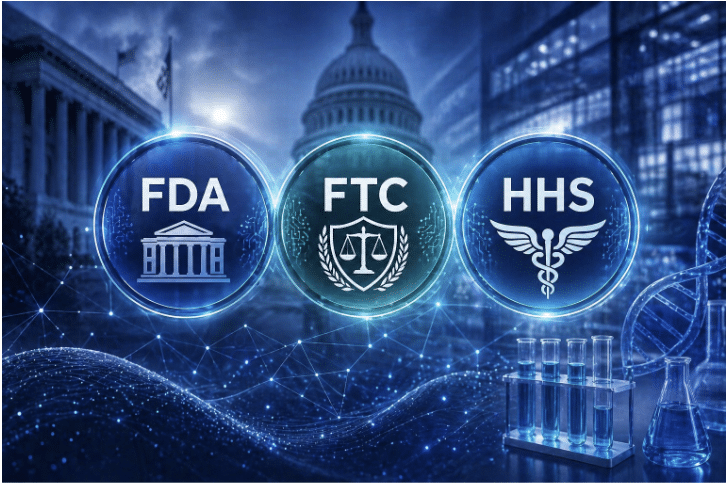
To stay informed, life science marketers must prioritize updates from agencies like the FDA, FTC, and HHS, as they provide the most actionable, domain-specific guidance. For example, the FDA’s Office of Prescription Drug Promotion (OPDP) now actively utilizes AI surveillance tools to detect misleading content and imbalances in risk/benefit reporting in direct-to-consumer materials.
Simultaneously, the FTC has launched Operation AI Comply to crack down on “AI washing”—the practice of overstating a tool’s capabilities in marketing materials.
A more comprehensive resource doc can be found here.
The critical takeaway for life science marketing leads is that AI authorship does not reduce your regulatory burden. Whether a human or an AI writes a social media post, the promotional standards remain the same.
Practical Takeaway: Establish a “Regulatory Watch” within your team to monitor the real-time AI rulemaking by the FDA and FTC.
Adopting the NIST AI Risk Management Framework (AI RMF)
As of May 2026, adopting the NIST AI RMF has moved from a voluntary suggestion to an industry expectation for demonstrating “reasonable” risk management. This framework allows marketing teams to categorize and track risks such as bias or inaccuracy before content is ever published. By implementing the four core functions—GOVERN, MAP, MEASURE, and MANAGE—organizations can document an audit trail of their AI use, which is essential for compliance.
This framework is particularly useful for teams managing “AI-enabled Software as a Medical Device” (SaMD), where transparency regarding training data and model performance is mandated by the CDRH.
- GOVERN: Establishes policies and accountability.
- MAP: Identifies risks like potential inaccuracy or bias in content tools.
- MEASURE: Analyzes and tests outputs for compliance before publication.
- MANAGE: Implements responses to risks and documents the decision-making process.
ACT framework: A daily standard for content creation
Upskilling in AI requires more than just learning how to write prompts; it requires a disciplined workflow for accountability. Sciencia Consulting utilizes the ACT Framework (Ask, Check, Tell) to govern all AI-assisted content development. This standard ensures that human experts remain “in the loop,” providing the nuanced scientific judgment that AI currently lacks.
- A | Ask: Before starting, ask if AI is the right tool and if the data is safe to use. Never input proprietary or patient data into public-facing tools.
- C | Check: Independently verify every fact, statistic, and citation, as AI can hallucinate incorrect information. Ensure the content meets FDA “fair balance” requirements.
- T | Tell: Maintain radical transparency by disclosing where and how AI was used, both internally and in regulatory submissions.
In the life sciences, transparency is an ethical standard and a regulatory expectation under FDA, FTC, and HHS frameworks.
Future-proofing your AI content strategy
Mastering AI in life science marketing requires a shift from viewing these tools as “content generators” to viewing them as components of a highly regulated system. By monitoring the enforcement postures of the FDA and FTC, adopting the NIST AI RMF for risk management, and strictly adhering to the ACT Framework, you can leverage GenAI to drive efficiency without compromising scientific integrity or regulatory compliance. You now have the resources and the mental model to turn AI from a liability into a competitive advantage.
Is your marketing team ready for the next wave of AI regulation? At Sciencia Consulting, we help life science companies build AI content centers of excellence grounded in data stewardship and human-in-the-loop accountability.
Connect with us today to explore how our governance frameworks can empower your team to innovate with confidence.